"Buoy Maker" sails down Raccoon Creek into Oriental Harbor
"Buoy Maker" is a beaut of a boat I regularly spot sailing around local waters. Here she is on a run out of Raccoon Creek into the anchorage of Oriental harbor after buzzing the Town Dock.
Now, I would call Buoy Maker a "gaff-rigged catboat," but certain people I know insist that that is a redundancy...
One of those people is this really really really old dude (and for you folks who live outside of Oriental, add another two or three "really"s) who thinks he can sail, tells me that if it has any other sail rig, it is not, by definition, a catboat of any sort whatsoever.
Well, the nameless critic may be from one of our Yankee states wherefrom catboats originate (state remains nameless to protect identity), and he may have owned a catboat or two (gaff-rigged, of course), but I maintain that a catboat can have ANY sail rig at all provided it is only one sail, there is no standing rigging (the mast is free-standing), and the mast sets way forward near the bow.
In any case, my critic and I can certainly agree that "Buoy Maker" is 100% "Catboat."
A Great Blue Heron stands near the edge of Raccoon Creek
A gray misty day here in Oriental.
The portion of Raccoon Creek in today's photo is separated by the Hodges' Street causeway from the navigable area of the creek where sailboats tie up at Town Dock and Oriental Marina & Inn and shrimp boat/trawlers tie up alongside the Town's two fish-houses, Point Pride Seafood (on the left) and Garland Fulcher Seafood (right).
The causeway is partially obscured by reeds at the other end of the water in today's photo, but you can see part of the wooden railing along the street.
Originally, Hodges Street ended at the northwest bank of Raccoon Creek (on the right side of today's photo.)
In 1908, the John L. Roper Lumber Company (which owned a large lumber mill across town) offered to supply the Town with the required materials if the Town would build a
"bridge across Raccoon Creek at the foot of Hodges St. and... get a right of way from the foot of said bridge on the East side of the creek out to Factory Street." Minutes of Board of Commissioners of Town of Oriental, February 4, 1908)
The property over which such road would pass was at that time owned by the Oriental Manufacturing Company, and had been the site of lumber mills and manufacturing operations.
The Bank of Oriental foreclosed on the Oriental Manufacturing Company property, and sold it to H.A. Stephens by a February 6, 1911 deed which specifically reserved an easement for:
"... a strip on the Northernmost end of said land running from Hodges St. to a point on Wall St. the Southern line of which is forty feet distant & parallel with the present Bridge walk across said Raccoon Creek from Hodges St. to said Wall St."
(this is the earliest recordation of the easement, and earliest reference to any causeway across Raccoon Creek so far found in Pamlico County land records... no original easement has yet been found)
At some point the Town replaced the "Bridge walk" across the creek with a road-bearing causeway, allowing vehicular traffic across the creek, but blocking water and water traffic.
Before the causeway blocked water traffic, boats could come up the creek as far as Main Street, which also traverses the creek, and is where I stood to take today's picture. Town co-founder Louis B. Midyette built the road now known as Main St. across the creek some time prior to 1898 (some 1898 deeds for properties between Factory St. and Raccoon Creek describe land as bordering on the "New Road built by L.B. Midyette.)
Boats could come up to a store on the bank of the creek just opposite of where the heron appears in today's picture (just out of camera shot on the left.) L.B. Midyette was an owner and co-owner of the store for awhile.
There has been some discussion removing the Main St. crossing over the creek, and possibly re-engineering the Hodges St. causeway to return the creek to its more natural state as an actual flowing creek...
Many folks don't even realize the bodies of water east of Hodges are the now-blocked remnants of Raccoon Creek. Many refer to the bodies of water between Hodges and Main and east of Main as the "Duck Ponds," which I think is an unfortunate nick-name in that it devalues the waters' actual status as the artificially-blockaded Raccoon Creek.
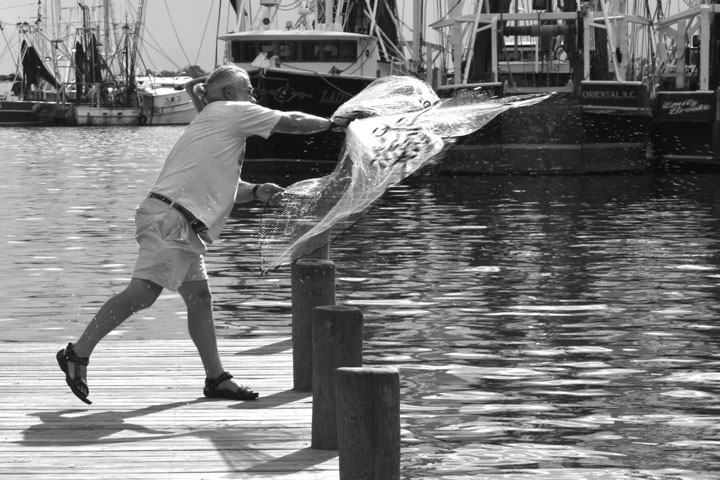
Casting a net for bait fish at Town Dock in Raccoon Creek, Oriental, NC.
This gentleman and his wife arrived at Town Dock in their inflatable dinghy this afternoon... while the wife went to The Bean for some coffee drinks, the husband took out his cast net and began casting for bait.
The couple live aboard their boat at Pecan Grove Marina, right across Smith Creek from Oriental (straight ahead as the camera points.) "Yeah, this dinghy is our car, and the boat is our house,"the wife explained to me.
Both I and the wife pointed out to the husband that there were thousands of Menhaden swimming around in a tight school near the Hodges Street bulkhead, 30 feet from Town Dock, but the husband wanted Pinfish, and was not interested in Menhaden... "They fall apart too easy," he said.
For those of you who have never used a cast net, this guy makes it look easy, but it just ain't so at first... I have been trying to learn, but I can't get it to spread out properly except maybe every fourth or fifth throw. See Capt. Robby trying to teach me at the end of the slide show on my Labor Day posting on The Dinghy Dock.
It seems just about every person has his or her own particular method of casting a net... just search "how to cast net" on YouTube, and you will come up with a dozen or more "how to" videos (watch one example below, with links to others), each involving different steps and techniques, and each one of which claims to be the easiest and most effective. The same is true of every fisher I have talked to in person... Typical instructions go along the lines of:
"You simply (coil the line in your throwing hand / coil in your non-throwing hand / let the line lay on the ground), then grab the net about (1/4, 1/3, 1/2, 3 feet, 4 feet down, waist-high, just above the waist, just below the waist), then grab the (front, rear, left, right) of the hanging lead-line (with your right pinky / left forefinger and thumb / in your teeth) then you grab (1/2, 1/3, 3/4, 5/8) of the remaining net in your (left / right/ throwing / non-throwing) hand, then put (this / that) part on your (left shoulder / right leg / left wrist / right elbow), do the hokey-pokey, blink three times, wiggle your right earlobe, and throw!"
Follow these easy instructions (!!!!) from "striper182" on YouTube and you too can throw a perfect cast net... after the video, a bunch of other cast-net instruction video links will pop up, all of course, just as simple:
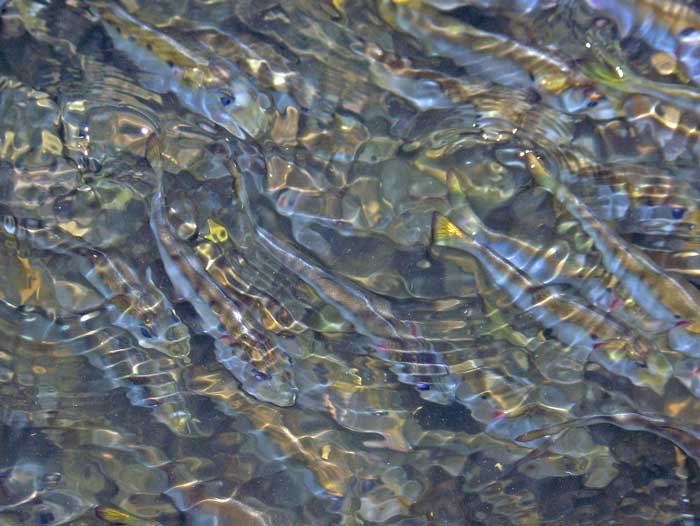
Menhaden (a type of fish) schooling next to the Hodges Street causeway over Raccoon Creek (next to Town Dock).
The menhaden invasion continues... Untold millions of menhaden minnows have thronged area creeks this summer, thriving in their estuaries.
The enormous schools of menhaden minnows create "boiling" effects along creek shores and docks. Especially on calm days, when the wind is not creating waves, the water everywhere seems to shimmer as the never-ending schools of tightly packed menhaden create surface turbulence.
I did take a video of the menhaden, since the still picture does not quite capture their frenetic nature:
All I Know About Menhaden (at least I think it's interesting):
Local crabbers (recreational and commercial) and recreational fishers use menhaden for bait. It is extremely easy to catch many hundreds of the 1 to 2 inch minnows simply by tossing a cast net from the shore.
People don't eat menhaden in their natural fish form, but commercial menhaden fisheries produce commercially successful proteins and oils extracted from the fish, as I learned last summer when I visited Reedville, Virginia.
Reedville, VA is home to the only menhaden fishing fleet on the Atlantic Ocean, and to a large processing plant that converts about 200,000 Tons of menhaden (over 500 Million individuals) a year into fishmeal and oil for use in a wide variety of products.
Like Oriental, Reedville is a small town dominated by a large commercial fishing fleet. Unlike the Oriental fleet, which concentrates on shrimping and some scalloping, the Reedville fleet is 100% dedicated to menhaden, which it harvests in enormous quantities.
While there, I spent a couple of hours at the Reedville Fisherman's Museum, which is essentially a propaganda outlet for the commercial menhaden industry (though they do also have an impressive floating collection of wooden boats, including one of about 30 surviving Chesapeake Bay "Skipjack" sailing oyster boats, which the museum continues to operate for charters and tours... all in all, well worth visiting.)
When you enter the museum, the docent immediately shunts you into a small room to watch a ten minute video about commercial menhaden fishing (the museum has now posted the video on YouTube, so I have embedded it below in this post)
Once properly indoctrinated, you are allowed wander the halls of the museum, which feature a pretty amazing photographic history of the industry in action, as well as scale models depicting key technological developments that have led to today's frighteningly large catches of the fish.
The modern menhaden fleet consists of about 10 "steamer" ships, each of which carries two smaller "purse-seine boats"...
When one of the fleet's associated airplanes spots one of the gigantic menhaden schools from the air, the steamer heads that way and launches the purse seine boats.
The purse seine boats each take one end of a 1500-foot purse seine net and encircle a portion of the school then close the bottom of the net, trapping the fish... The area within the net may only be a tiny piece of the overall school, but will result in a catch of up to 300,000 menhaden.
The fish are then pumped out of the nets by the steamers (using giant vacuum tubes that are lowered into the trapped mass.) When their holds are filled, the purse seine boats are brought back aboard and the steamers head back to the processing plant at Reedville.
At the plant, the fish is "cooked" and pressed, separating it into "liquor" (water and oil) and "cake" (solid fish meal). If you are ever in Reedville, you will immediately know if the plant is cooking, as an odor-you-would-not-believe pervades the air downwind of the plant... make sure to anchor or tie up on the windward side of the stacks! (Crazy Crab Restaurant and Marina is recommended, so long as the wind is not out of the south)
The dry meal is used, among other things, as a protein for livestock and pet foods. (take a deep whiff of a can of fish food flakes, or while in the cat food aisle at Pet Smart and you will have a small clue as to the odor that emanates from the processing plant)
The oil is mostly exported to Europe for use as cooking oil/margarine/shortening for human foods (as the Reedville Fisherman's Museum film points out, if you've ever been to France and enjoyed their croissants, likely cooked with menhaden oil), but because the American market has so far not embraced menhaden as a food oil it is instead used here for industrial products like paint and cosmetics.
If you only watch the Reedville Museum's film (embedded below) you might think, as the narrator asserts, that it is indeed:
"the perfect commercial fish... fishermen don't value them except as bait [not good eating, plus they are toothless phytoplankton eaters not catchable with hook and line so sports fishers don't care about them]... they are plentiful, self-renewing, usable in a variety of ways and catchable in large quantities without accidentally killing other valuable fish that people want to eat or catch for sport."
(Video from the Reedville Fisherman's Museum, Reedville, VA)
Some conservationists and sports fishers, however, complain that because menhaden are a significant link between plankton and larger predatory marine and avian life, the large-scale removal of their protein from the ecosystem can only have damaging effects on predator populations such as striped bass, bluefish, mackerel, flounder, tuna, drum , sharks, egrets, ospreys, seagulls, northern gannets, pelicans, herons, etc... Some allege that commercial menhaden fishing has even led or contributed to an alarming increase in appearances of lesion-causing mycobacteriosis and Pfiesteria among menhaden predators such as bass and rockfish.
The U.S. Dept. of Commerce's National Oceanic and Atmospheric Administration projects that this year the 10 steamers of the Reedville-based Atlantic menhaden fleet will bring in close to 200,000 Tons of menhaden! (see NOAA report)
According to NOAA, the combined Gulf and Atlantic menhaden fleets landed 454,000 metric tons (1.39 BILLION pounds) of the fish last year.
I won't bother linking to the multitude of sources discussing the debate over whether menhaden are being over-fished to the detriment of other species (and whether that is even possible)... if you are interested, you can google and find tons of discussion on the subject, most of which appears in the form of defensive discussions from the commercial fishing interests.
I found another menhaden fishing video on YouTube, very different from the pre-packaged corporate promo like the video from the Reedville museum... This vedeo was apparently made by one or more commercial menhaden fishermen (accompanied by Dire Straits' "Sultans of Swing")... Oddly, these guys are fishing off Cape May, NJ, and the boats are not the large "steamers" of the Reedville fleet... not sure where they are from, but it looks like they use the two trawlers for the purse-seine operation... one of the trawlers carries a smaller boat (the loading-the-boat scene is my favorite part), but this is not like the huge Reedville steamers each carrying two 20 foot steel-hulled purse-seine boats.
These guys clearly enjoyed making the video for fun. It's also clear from the video that these guys work hard catching bunk/pogies/menhaden, and that they love being fishermen working the waters. Check it out:"bunker fishing cape may (atlantic menhaden)" video.
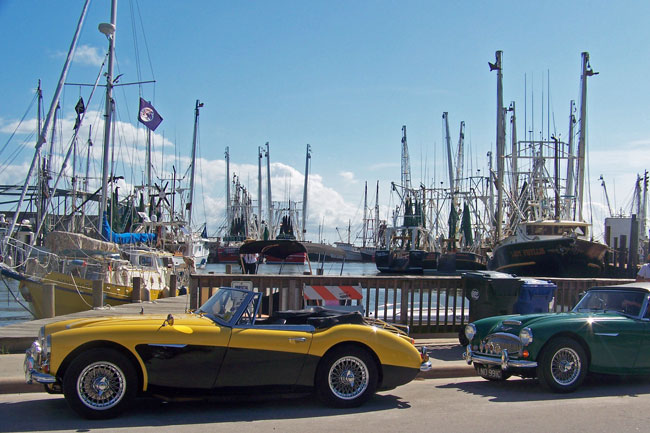
About a dozen Austin-Healeys and other British sports/roadsters parked on Hodges Street between Town Dock and The Bean coffee shop today as the Austin-Healey Club of America held its annual "ice cream social."
Owners (and some passengers) met for Ice Cream at Oriental's premiere coffee and ice cream shop, "The Bean," this year.
Most of the Austin-Healeys were "3000 MK" models (including both cars appearing in today's photo), though there was at least one "bugeye" Sprite as well. Also in the mix were several MGs, a Lotus Mark 7 and a Jaguar XKE.
I really liked the yellow/black Austin-Healy juxtaposed with the equally yellow "Nantascot" tied up at Town Dock in the background.
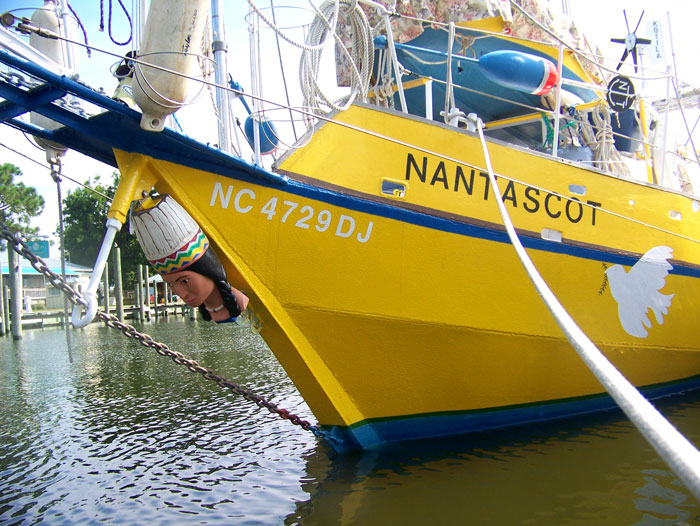
"Nantascot," a steel-hulled, cutter-rigged sailboat, pulled into the Town Dock today.
She is the only boat I have ever seen in Oriental with an actual figurehead. The carved figurehead is named "Nana."
I found a website for the boat, but it appears the Captain set up the site and has not done much with it, though it does have a number of photos and a lot of information about the vessel... See the "Sailboat Nantascot" site here.
According to the website:
"Nantascot is a 28’9” Bruce Roberts ["Spray" model] steel hull cutter.
"Originally launched in 1992, but never sailed by her first owner [who built her in his garden]... The vessel was redesigned and rebuilt complexly by her new owners... During the five and a half year process approximately 2 tons of steel, fittings and equipment were added. The most obvious design changes were the addition of a pilot house and an aft extension."
Also, the Captain built an "unsinkable survival raft" that sits on the forward deck and required a new foresail design to keep the sail from catching on the raft. The blue hull and yellow side of the raft is visible in this picture, though the raft was covered in what looked like a floral-print curtain.
If you would like to build your own Bruce Roberts-designed sailboat (or power boat for that matter), whether wood, glass or steel, visit the Official Bruce Roberts site and order your plans today!
Along the "Inner Banks" of North Carolina...where everyone lives at the end of the road, and every road ends at the water!
Humans: 875... Sailboats: 3,000 View Oriental, NC in a larger map
Search Oriental Daily Photo (also see topics index, below)


 "Buoy Maker" sails down Raccoon Creek into Oriental Harbor


 Posts
Posts


