Sandy shows off the Red Drum she and husband Robby caught today
As I was pedaling past her house, my neighbor flagged me down to get me to take some pictures of two Red Drum (sciaenops ocellatus) she and her husband caught this morning from their Mako (background).
They were caught in a local creek, though of course I can't reveal exactly where... The largest measured 25 inches, the smaller 23. Not sure which one was hers and which was Robby's, but both were pleased with the morning's catch!
Today I drove my visiting brother Fred around for a tour of Pamlico County.
Found this catfish drop-box for ramp fees at the Paradise Cove Marina boat ramp. I was surprised to see that the catfish itself is approved for use as a U.S. Postal Service delivery box (before it was modified, at least.)
Paradise Cove Marina expanded it's marina this year... The marina also boasts a fine bar / deck, open weekends during the season, and available for private parties.
Great place for a sunset and refreshments during the season... but remember to bring some DEET!
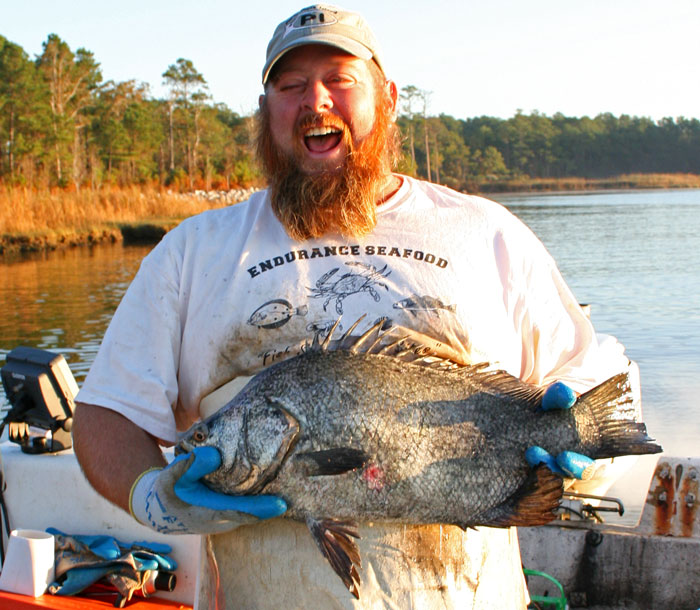
Captain Keith Bruno is pleased with this Atlantic Tripletail (Lobotes surinamensis) he pulled from one of his gill-nets along the Neuse River near Pierce Creek
Bruno, a commercial fisherman, does his own catching and his own retail selling of many fruits of the local waters... But after removing the rare Tripletail catch from his net, he proclaimed "you can't buy this one from me!"
Today and tomorrow, I will be bending the "City Daily Photo" rules to introduce you to Captain Bruno.
I hope you enjoy meeting him as I did...
Today I had the pleasure of accompanying Endurance Seafood owner Capt. Keith Bruno as he pulled his gill-nets set the previous night along the banks of the Neuse River and Smith's Creek. Bruno's prize catch of the day was the handsome Tripletail featured in today's photo.
Like not a few of Oriental's residents, Bruno has long experience working on water, and more than a few tales to tell about it...
From blood-curdling terror in the "Perfect Storm" of the North Atlantic to karmic respite along the sun-drenched beaches and ports of the Mediterranean... from a penniless vagabond sleeping under the docks of Bermuda to successful lobster baron... from cut-throat competition and anti-viral devastation of the New York lobster fishery to a happy family home in the welcoming world and diverse fisheries of Down East North Carolina...
Endurance:
en-dur-ance... n 1: PERMANENCE, DURATION 2: the ability to withstand hardship or adversity...
en-dure... vb 1: to undergo (as a hardship) especially without giving in...
Bred for Water:
Bruno, now 40, began his lifetime of working the waters as a 5 year-old, apprenticing with his father fishing lobsters out of Smithtown, N.Y., on Long Island Sound.
From 1989 to 1991, Bruno worked on lobster boats, first working the inshore fishery, then moving up to the tougher world and better money of offshore lobstering.
The Perfect Storm:
In 1991, as a weakening hurricane Grace was working her way into the North Atlantic, the offshore lobster boat which was Bruno's workplace and home for 7 of every 10 days, began heading back to port.
Before making it back, however, the boat was overtaken by the infamous "Perfect Storm" of 1991 (the one that killed the captain and 5 crew of the Andrea Gail, as fictionalized in the George Clooney movie)...
As the lobster boat struggled through the heavy storm-torn seas, Bruno was on deck when the boat broached to in the trough of mountainous waves. Lying parallel to the waves in the trough, the boat was helpless as the towering following wave crashed on top of her. Bruno was crushed against the bulwark by the deck-load of lobster traps and tons of water enveloping the boat as the wave tore abrest.
Being so pinned down by the weight and pressure of the traps and water may well have saved Bruno from being immediately washed over the open transom or out of a scupper to certain death in the stormy seas, but Bruno's legs were injured and his body heat had been sucked out by the mass of chilly water that flooded his protective oilskin foul-weather gear.
As Bruno struggled to re-orient himself on the open deck of the still-broached vessel, a crewmate grabbed him by the collar, hauled him into the cabin, unceremoniously dumped him on the floor where he lay alone as the crewmate returned to the danger on deck.
Sometime later, perhaps an hour or so, Bruno regained his senses enough to begin removing the soaked clothing from his chilled and battered body in an attempt to begin raising his body temperature.
While Bruno struggled to remove his upper garments, the boat's Captain entered the cabin, saw Bruno moving and growled that it looked like he was ready to go back to work. When Bruno understandably indicated that indeed he was not so ready, the Captain expressed his great displeasure at the news, and added some comments to the effect that Bruno seemed to lack certain traits of male anatomy.
Again later, as Bruno continued to struggle removing his dangerously cold and wet clothing, and as he realized his legs had been so injured as to prevent him from walking, much less assisting the crew on the heaving deck in the storm, the Captain returned to ask Bruno if he was finished with his beauty rest and ready to return to the world of working men, only to be dissapointed again by Bruno's negative response.
The next day, the storm abated but Bruno still battered, the Captain again asked if Bruno were ready to go back to work. While Bruno understood and expected that the boat would not discontinue further lobster fishing to take his injured self back to port, he knew he was not able to return to the physical work of the crew.
The Captain informed Bruno that he would not rate any pay for the remaining days at sea, and that Bruno was welcome to return to crying like a girl in his berth until the boat returned to port.
The Shore of Refuge:
Back ashore and out of the lobstering business, Bruno began recovering from his injuries.
Bruno received a call from an old friend who asked him if he was available for work. Bruno explained that he was not fit for the work of commercial lobster fishing...
"But do you think you could sail?" he was asked. Bruno had sailed on a shooner one summer in his youth - just day-sailing, no cruising or ocean voyages, but Bruno knew the fundamentals of sailing.
"Sure, I can sail."
"Well, I need a boat delivered to Bermuda... I can offer you all your provisions for the trip, of course, and a return plane ticket plus a little pocket money... at least think about it."
Bruno thought about it, and two days later had consented to the job.
Bruno sailed the boat to Bermuda, still in pain and limited by his injury on the voyage. Upon his arrival, where he was required to stay aboard the fully-provisioned boat for a time, Bruno discovered his pain and injuries were nothing that all the rum in Bermuda couldn't cure.
When his pocket money ran out, Bruno cashed in his plane ticket. When vacated from the boat by the arrival of the boat's owner, Bruno's employer offered to loan Bruno money for a new plane ticket. Bruno decided not to accept the loan, and to stay in Bermuda.
Out of cash, with no family or friends and few acquaintances on the island, Bruno found serviceable accommodations underneath a dock on the beach...
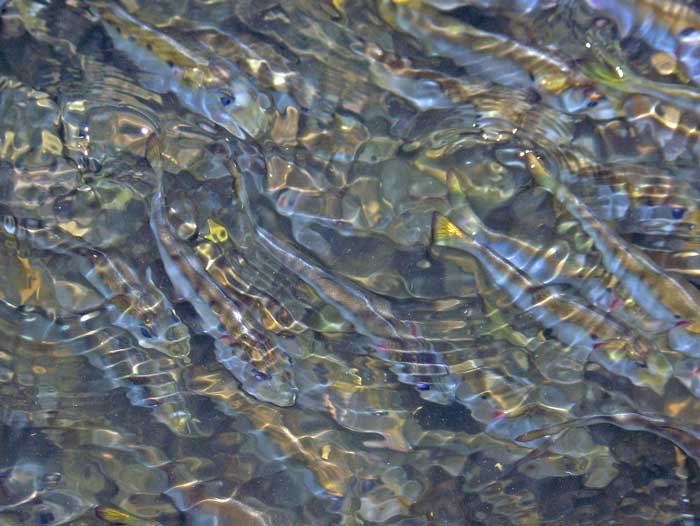
Menhaden (a type of fish) schooling next to the Hodges Street causeway over Raccoon Creek (next to Town Dock).
The menhaden invasion continues... Untold millions of menhaden minnows have thronged area creeks this summer, thriving in their estuaries.
The enormous schools of menhaden minnows create "boiling" effects along creek shores and docks. Especially on calm days, when the wind is not creating waves, the water everywhere seems to shimmer as the never-ending schools of tightly packed menhaden create surface turbulence.
I did take a video of the menhaden, since the still picture does not quite capture their frenetic nature:
All I Know About Menhaden (at least I think it's interesting):
Local crabbers (recreational and commercial) and recreational fishers use menhaden for bait. It is extremely easy to catch many hundreds of the 1 to 2 inch minnows simply by tossing a cast net from the shore.
People don't eat menhaden in their natural fish form, but commercial menhaden fisheries produce commercially successful proteins and oils extracted from the fish, as I learned last summer when I visited Reedville, Virginia.
Reedville, VA is home to the only menhaden fishing fleet on the Atlantic Ocean, and to a large processing plant that converts about 200,000 Tons of menhaden (over 500 Million individuals) a year into fishmeal and oil for use in a wide variety of products.
Like Oriental, Reedville is a small town dominated by a large commercial fishing fleet. Unlike the Oriental fleet, which concentrates on shrimping and some scalloping, the Reedville fleet is 100% dedicated to menhaden, which it harvests in enormous quantities.
While there, I spent a couple of hours at the Reedville Fisherman's Museum, which is essentially a propaganda outlet for the commercial menhaden industry (though they do also have an impressive floating collection of wooden boats, including one of about 30 surviving Chesapeake Bay "Skipjack" sailing oyster boats, which the museum continues to operate for charters and tours... all in all, well worth visiting.)
When you enter the museum, the docent immediately shunts you into a small room to watch a ten minute video about commercial menhaden fishing (the museum has now posted the video on YouTube, so I have embedded it below in this post)
Once properly indoctrinated, you are allowed wander the halls of the museum, which feature a pretty amazing photographic history of the industry in action, as well as scale models depicting key technological developments that have led to today's frighteningly large catches of the fish.
The modern menhaden fleet consists of about 10 "steamer" ships, each of which carries two smaller "purse-seine boats"...
When one of the fleet's associated airplanes spots one of the gigantic menhaden schools from the air, the steamer heads that way and launches the purse seine boats.
The purse seine boats each take one end of a 1500-foot purse seine net and encircle a portion of the school then close the bottom of the net, trapping the fish... The area within the net may only be a tiny piece of the overall school, but will result in a catch of up to 300,000 menhaden.
The fish are then pumped out of the nets by the steamers (using giant vacuum tubes that are lowered into the trapped mass.) When their holds are filled, the purse seine boats are brought back aboard and the steamers head back to the processing plant at Reedville.
At the plant, the fish is "cooked" and pressed, separating it into "liquor" (water and oil) and "cake" (solid fish meal). If you are ever in Reedville, you will immediately know if the plant is cooking, as an odor-you-would-not-believe pervades the air downwind of the plant... make sure to anchor or tie up on the windward side of the stacks! (Crazy Crab Restaurant and Marina is recommended, so long as the wind is not out of the south)
The dry meal is used, among other things, as a protein for livestock and pet foods. (take a deep whiff of a can of fish food flakes, or while in the cat food aisle at Pet Smart and you will have a small clue as to the odor that emanates from the processing plant)
The oil is mostly exported to Europe for use as cooking oil/margarine/shortening for human foods (as the Reedville Fisherman's Museum film points out, if you've ever been to France and enjoyed their croissants, likely cooked with menhaden oil), but because the American market has so far not embraced menhaden as a food oil it is instead used here for industrial products like paint and cosmetics.
If you only watch the Reedville Museum's film (embedded below) you might think, as the narrator asserts, that it is indeed:
"the perfect commercial fish... fishermen don't value them except as bait [not good eating, plus they are toothless phytoplankton eaters not catchable with hook and line so sports fishers don't care about them]... they are plentiful, self-renewing, usable in a variety of ways and catchable in large quantities without accidentally killing other valuable fish that people want to eat or catch for sport."
(Video from the Reedville Fisherman's Museum, Reedville, VA)
Some conservationists and sports fishers, however, complain that because menhaden are a significant link between plankton and larger predatory marine and avian life, the large-scale removal of their protein from the ecosystem can only have damaging effects on predator populations such as striped bass, bluefish, mackerel, flounder, tuna, drum , sharks, egrets, ospreys, seagulls, northern gannets, pelicans, herons, etc... Some allege that commercial menhaden fishing has even led or contributed to an alarming increase in appearances of lesion-causing mycobacteriosis and Pfiesteria among menhaden predators such as bass and rockfish.
The U.S. Dept. of Commerce's National Oceanic and Atmospheric Administration projects that this year the 10 steamers of the Reedville-based Atlantic menhaden fleet will bring in close to 200,000 Tons of menhaden! (see NOAA report)
According to NOAA, the combined Gulf and Atlantic menhaden fleets landed 454,000 metric tons (1.39 BILLION pounds) of the fish last year.
I won't bother linking to the multitude of sources discussing the debate over whether menhaden are being over-fished to the detriment of other species (and whether that is even possible)... if you are interested, you can google and find tons of discussion on the subject, most of which appears in the form of defensive discussions from the commercial fishing interests.
I found another menhaden fishing video on YouTube, very different from the pre-packaged corporate promo like the video from the Reedville museum... This vedeo was apparently made by one or more commercial menhaden fishermen (accompanied by Dire Straits' "Sultans of Swing")... Oddly, these guys are fishing off Cape May, NJ, and the boats are not the large "steamers" of the Reedville fleet... not sure where they are from, but it looks like they use the two trawlers for the purse-seine operation... one of the trawlers carries a smaller boat (the loading-the-boat scene is my favorite part), but this is not like the huge Reedville steamers each carrying two 20 foot steel-hulled purse-seine boats.
These guys clearly enjoyed making the video for fun. It's also clear from the video that these guys work hard catching bunk/pogies/menhaden, and that they love being fishermen working the waters. Check it out:"bunker fishing cape may (atlantic menhaden)" video.
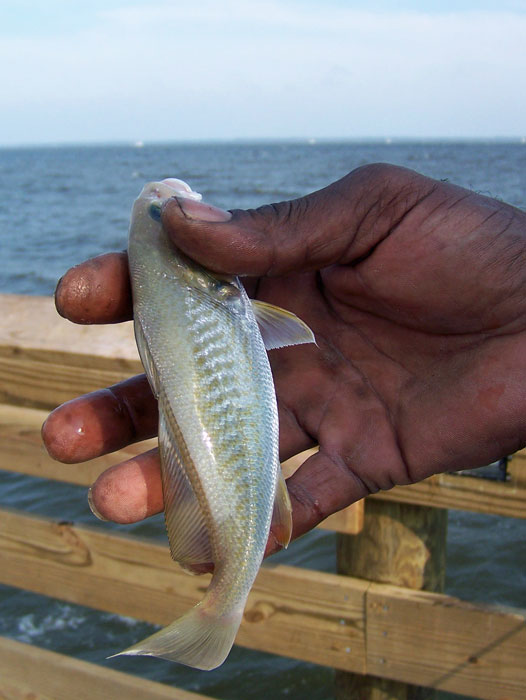
This is a "Croaker"(Micropogonias undulatus), the namesake for Oriental's annual summer festival, "Croakerfest," held the first weekend in July. A Croaker effigy is also dropped from a sailboat mast at midnight New Year's Eve after the Running of the Dragon.
This fish was caught today from the new fishing pier at Lou-Mac Park in Oriental. The white specks out on the river (above hand) are commercial trawlers shrimping on Garbacon Shoal, across the Neuse River from Oriental.
Despite its' importance to Oriental Holidays, few locals eat croaker, complaining that it is too oily and bony, and its' large head means little edible flesh. The fisher who caught this one told me he eats them all the time.
Croaker get they're name from the fact that they make a loud croaking noise (a bit like the purring of a 20 pound house-cat), which this one was doing with abandon. They create the sound by beating abdominal muscles against their swim bladder.
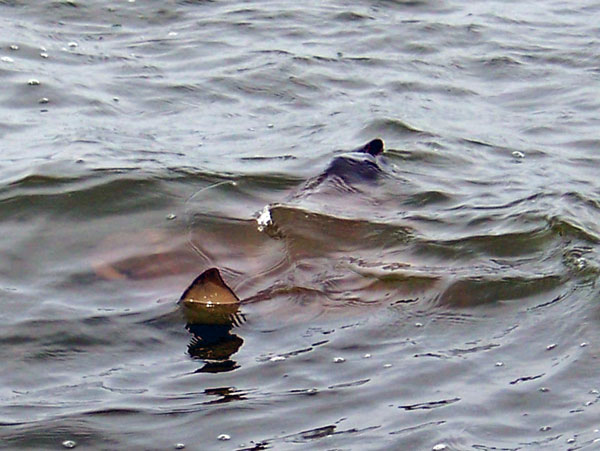
I think this is a Cownose or Bullnose Ray. I noticed it splashing/swimming/hunting in the Neuse River between ten and thirty feet off the South Avenue waterfront.
Some people have told me that when you see the double fins cutting along the top of the water (actually the tips of the 'wings') that it is a Skate. I don't think so, though, because Skates are bottom-dwellers, and the Rays swim, hunt and even jump above the water according to my internet research. The bit of the head that is visible in this picture and the coloring of the creature also point to a Cownose or a Bullnose Ray.
This one did a bit of splashing at the surface while I was watching. I have seen these creatures just under the surface while sailing or walking along the Neuse, but this is the first time I've seen one splashing and moving with both wings sticking out of the water. You can't see it in the pictures, but this creature was cruising around a large school of small fish, and I saw a number of them jumping out of the water around this Ray.
Along the "Inner Banks" of North Carolina...where everyone lives at the end of the road, and every road ends at the water!
Humans: 875... Sailboats: 3,000 View Oriental, NC in a larger map
Search Oriental Daily Photo (also see topics index, below)


 Sandy shows off the Red Drum she and husband Robby caught today



 Posts
Posts


